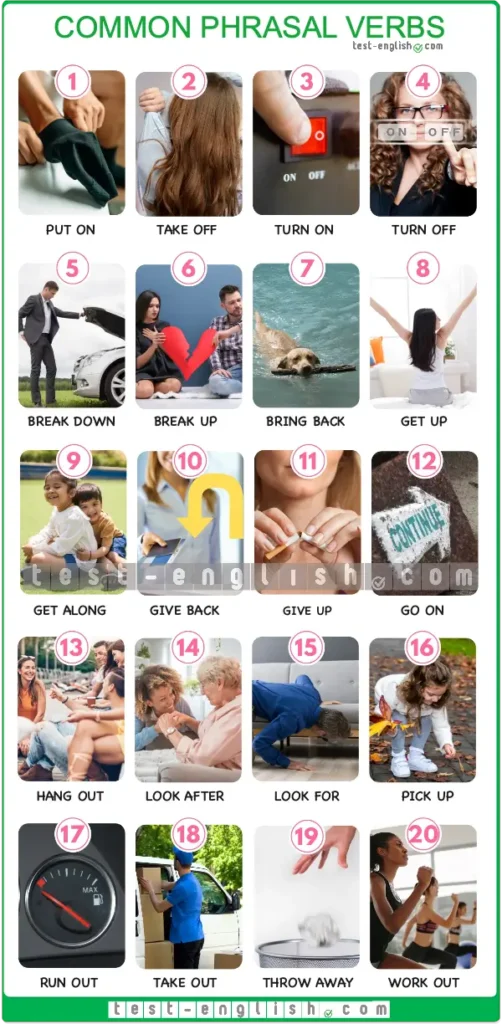
Common-phrasal-verbs-a2-english-vocabulary
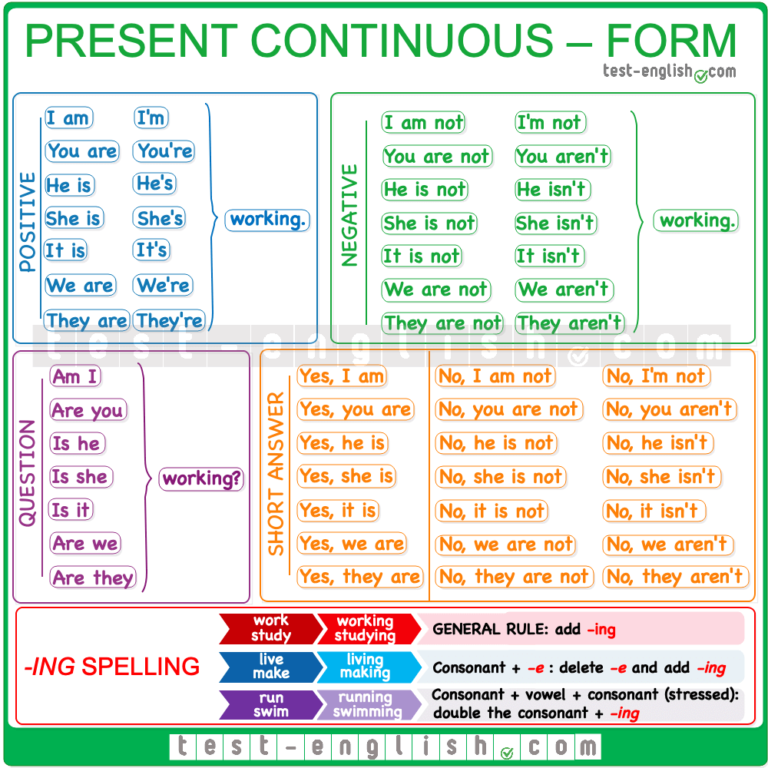
We form the present continuous with am/is/are + the -ing form of the verb.
- I am writing a book.
- She is listening to the radio.
- They are doing their homework.
The short forms of am/is/are are: ‘m/’s/’re.
- I‘m writing a book.
- She‘s listening to the radio.
- They‘re doing their homework.
The negative short forms of am not/is not/are not are: ‘m not/isn’t/aren’t.
- I‘m not writing a book.
- She isn’t listening to the radio.
- They aren’t doing their homework.
Note that we can use short forms only in negative short answers, but not in positive short answers.
- ‘Are you writing a book?’ ‘No, I’m not/I am not.’
- ‘Are you writing a book?’ ‘Yes, I am.’
- ‘Are you writing a book?’ ‘Yes, I’m.’


Actions happening now
We use the present continuous for things happening now, at the moment of speaking.
- ‘What are you doing?’ ‘I‘m watching TV.’
Actions happening around now
We use the present continuous for temporary things that are happening around now (=not at the moment of speaking but these days, or weeks, etc.)
- I‘m reading a very good book at the moment. (=I’m not reading it at the moment I’m speaking, but I’m reading it these days.)
Now, these days, at the moment, etc.
We use the present continuous with time expressions that mean ‘now’ or ‘around now’: now, at the moment, at present, today, these days, this week, etc.
https://test-english.com/grammar-points/a1/present-continuous
https://agendaweb.org/exercises/verbs/present-continuous-2.h
2.Write down 10 sentences with these verbs
3. Revise the grammar and pass the tests
2. https://www.engblocks.com/grammar/exercises/tenses/present-continuous-negative/
3.https://www.engblocks.com/grammar/exercises/tenses/present-continuous-yes-no-question/
This is just a placeholder to help you visualize how the content is displayed in the tabs. Feel free to edit this with your actual content.