Teaching Piano Basics in English
Warm-up
- How many stages do you have in class?
- What is happening during your class apart from playing the piano?
- What does your job as a teacher require from you?
Useful piano vocabulary
Piano Story Cases Using Terminology
Octave
“Today we will practice playing this melody in the higher octave,” said the teacher.
UA: «Сьогодні ми потренуємося грати цю мелодію у вищій октаві.»Note
“Listen carefully to this note. Can you play it correctly?”
UA: «Слухай уважно цю ноту. Чи можеш її правильно зіграти?»Scale
“Let’s start with a C major scale to warm up our fingers,” the teacher suggested.
UA: «Давайте почнемо з гамми до мажор, щоб розігріти пальці.»Chord
“Now play the C major chord with both hands,” said the teacher.
UA: «Тепер зіграйте акорда до мажор обома руками.»Finger numbers
“Use finger number 1 for the thumb and number 5 for your little finger,” reminded the teacher.
UA: «Використовуйте палець номер 1 для великого пальця і номер 5 для мізинця.»Dynamics
“Play this part softly, piano, and then the next part loudly, forte,” the teacher instructed.
UA: «Зіграйте цю частину тихо – piano, а наступну – гучно – forte.»Staccato
“This passage should be played staccato, short and detached,” said the teacher.
UA: «Цей відрізок слід грати стакато – коротко і відокремлено.»Legato
“Try to play the melody legato, smoothly connecting all the notes,” advised the teacher.
UA: «Спробуй зіграти мелодію легато – плавно зв’язуючи всі ноти.»Treble clef
“The right hand will read the notes on the treble clef,” explained the teacher.
UA: «Права рука буде читати ноти зі скрипкового ключа.»Bass clef
“Your left hand will play the bass clef notes,” said the teacher.
UA: «Ліва рука буде грати ноти басового ключа.»Rest
“Don’t forget the rests – a rest is silence,” the teacher reminded.
UA: «Не забувайте про паузи – пауза означає тишу.»Interval
“Notice the interval between these two notes – it is a perfect fifth,” said the teacher.
UA: «Зверніть увагу на інтервал між цими нотами – це чиста квінта.»Arpeggio
“Play the C major chord as an arpeggio, one note at a time,” the teacher instructed.
UA: «Зіграйте акорда до мажор арпеджіо – по одній ноті за раз.»Key signature
“Check the key signature – all F notes are sharp,” said the teacher.
UA: «Перевірте тональність – всі ноти F підвищені (дієз).»Tempo
“Let’s slow down the tempo here to make it easier,” advised the teacher.
UA: «Давайте сповільнимо темп, щоб було легше.»Grand staff
“Both hands together read from the grand staff,” the teacher said.
UA: «Обидві руки грають, читаючи з загального нотного стану.»Scale degrees
“The first scale degree is the tonic, the fifth is the dominant,” explained the teacher.
UA: «Перша ступінь гами – тоника, п’ята – домінанта.»Accidental
“This note has an accidental – it’s sharp,” the teacher noted.
UA: «Ця нота має альтерацію – дієз.»Sharp
“Play the F sharp here, remember it is raised by a half step,” the teacher reminded.
UA: «Зіграйте F дієз – ноту підвищено на півтону.»Flat
“This B flat lowers the note by a half step,” said the teacher.
UA: «Цей B бімоль знижує ноту на півтону.»Pedal
“Use the pedal to sustain these notes,” instructed the teacher.
UA: «Використайте педаль, щоб продовжити звучання нот.»
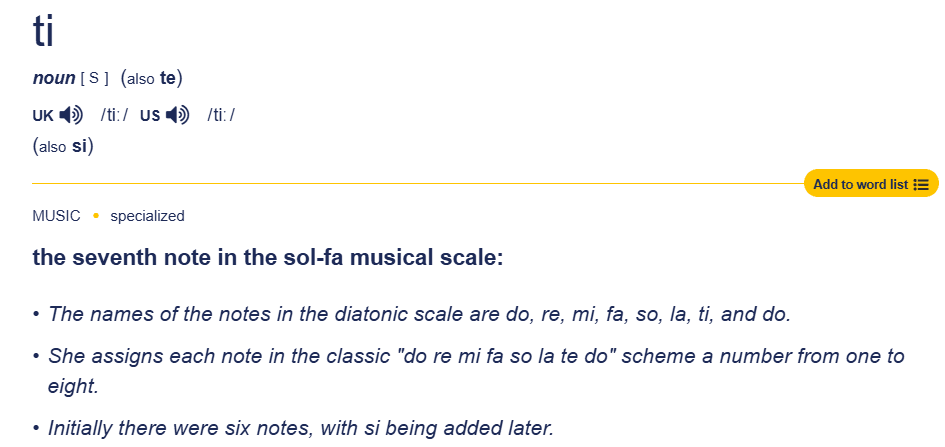
Fun fact about note “ti”
Do, Re, Mi, Fa, Sol, La, Ti are solfège syllables – a way to name the notes of the scale.
Reading practice
The Complete Guide to Solfege for Elementary Music Teachers – click here
Fixed Do vs Movable Do – click here