Lesson 5: Mastering the American T & D Sounds
In this lesson, we’ll explore the different ways the sounds D and T are pronounced in American English. These variations, including the Flap T, Fast D, and others, are essential for fluent and natural-sounding English. Let’s dive in!
Explanation
Picture of the mouth – alveolar ridge
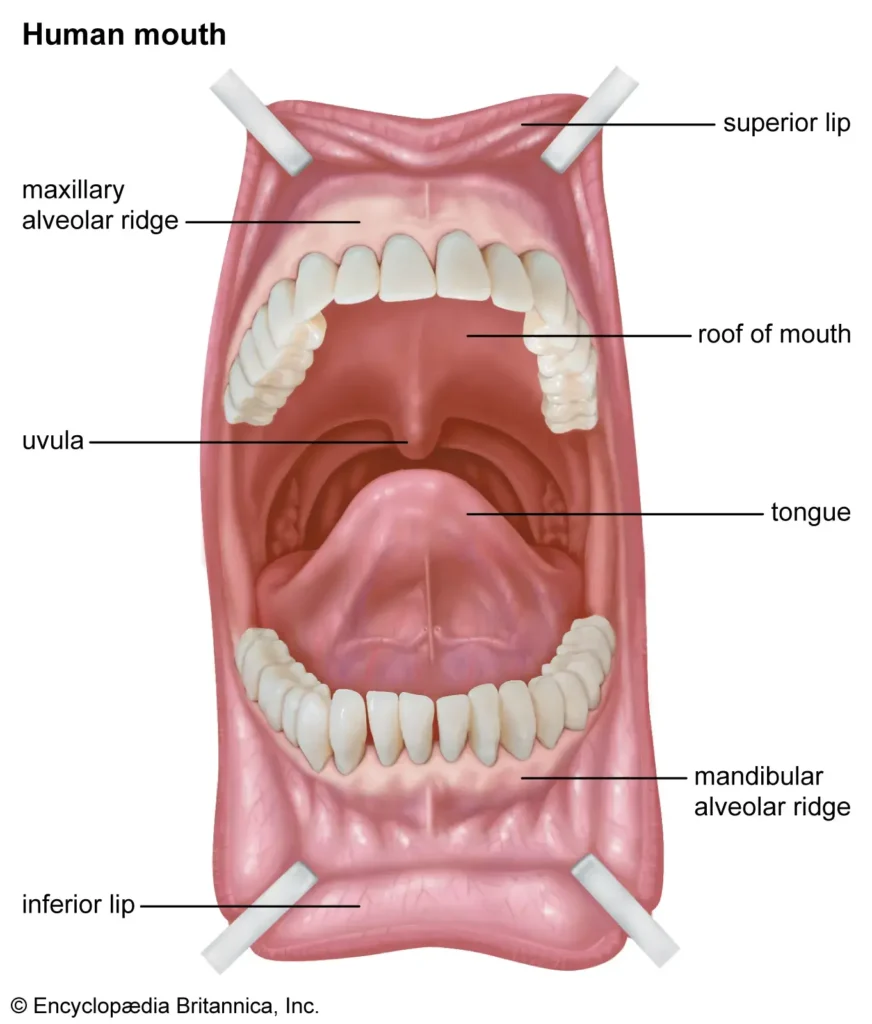
Examples of widely used words:
- Dog
- Dad
- Day
- Did
- Dance
- Door
- Decide
- Doctor
- Deal
- Disappoint
- Determination
- Definition
- Destroy
- Destabilize
- Disappear
Sound T in the Beginning of Words
The “T” sound is voiceless, produced by tapping the tongue against the alveolar ridge without vibrating the vocal cords.
Explanation
Examples of widely used words:
- Time
- Ten
- Top
- Table
- Tell
- Tomorrow
- Taste
- Tall
- Team
- Take
- Tea
- Town
- Talk
- Together
- Teenager
Flap T in the Middle of Words
The Flap T sounds like a quick “D” and often appears between vowels in American English. It is softer and quicker than the normal “T.”
Explanation
Examples of widely used words:
- Better
- Water
- Writer
- City
- Matter
- Little
- Later
- Meeting
- Party
- Pretty
- Battle
- Total
- Title
- Fatter
- Sweater
Sound T vs Flap T
The “T” sound in its normal form is pronounced clearly at the start of words or stressed syllables, while the Flap T softens between vowels.
Explanation
Examples:
T: Time, Table, Tall, Town
Flap T: Water, Better, Little, City
Fast D Explanation
In rapid speech, the “D” sound becomes faster and softer between vowels, similar to the Flap T.
Examples of widely used words:
- Ladder
- Leader
- Ready
- Needed
- Medicine
- Medal
- Reading
- Heading
- Wedding
- Order
- Hidden
- Body
Stopped T vs Stopped D
In certain words, especially at the end of a syllable or phrase, “T” and “D” can stop abruptly, without a full release.
Explanation
Examples of widely used words:
- Cat
- What
- Hit
- Mad
- Red
- Bed
- Bad
- Hot
- Put
- Sad
- Fit
- Head
- Lead
- Bit
- Bread
CHR, DJR, CH, DJ
In American English, the combination of “T” and “R” often sounds like “CHR,” while “D” and “R” sound like “DJR.” Similarly, “T + U” can sound like “CH,” and “D + U” sounds like “DJ.”
Explanation
Examples of widely used words:
T + R = CHR:
- Train
- Tree
- Try
- Travel
- Trust
D + R = DJR:
- Dream
- Dry
- Drive
- Dress
- Drink
T + U = CH:
- Nature
- Future
- Picture
- Adventure
- Creature
D + U = DJ:
- Education
- Individual
- Gradual
- Schedule
- Procedure
Hold T Before N (Glottal Stop)
When “T” comes before an “N” in certain words, especially in American English, the “T” is not fully released. Instead, the sound is stopped in the throat, which is known as a glottal stop. The vocal cords close, and the “T” sound is cut off without releasing air.
Explanation
Examples:
- Mountain (pronounced as “moun’n”)
- Button (pronounced as “bu’n”)
- Cotton (pronounced as “co’n”)
- Kitten (pronounced as “ki’n”)
- Fountain (pronounced as “foun’n”)
- Certain (pronounced as “cer’n”)
- Written (pronounced as “wri’n”)
- Eaten (pronounced as “ea’n”)
- Mitten (pronounced as “mi’n”)
- Forgotten (pronounced as “forgo’n”)
Drop T/D in the Middle of Words
In casual American English, the “T” or “D” sound can be completely dropped in the middle of some words. This usually happens when the sound comes between two vowels, especially in unstressed syllables, making speech sound quicker and more natural.
Explanation
Examples:
- Internet (pronounced as “in’ernet”)
- International (pronounced as “in’ernational”)
- Center (pronounced as “cen’er”)
- Hundred (pronounced as “hun’red”)
- Exactly (pronounced as “exac’ly”)
- Yesterday (pronounced as “yes’erday”)
- Saturday (pronounced as “Sa’urday”)
Normal T Explanation
We pronounce the “T” sound clearly when it appears before an unvoiced consonant. In these cases, the “T” is not dropped or altered.
Explanation
Examples:
- fact
- missed
- list
- best
- clapped
- gift
- wished
NT Sounds Like NN
In many American English words, the “NT” combination can sound like “NN”. The “T” is softened or even replaced with a quick “N” sound in casual speech.
Examples:
- document (“documen”)
- center (“cenner”)
- wanted (“wanned”)
- Internet (“Innernet”)
- twenty (“twenny”)
- want to (“wanna”)
- counter (“counner”)
- counted (“counned”)
- disappointed (“disappoinned”)
Practice Makes Perfect
Explanation
- I need to talk to you about the best way to solve this problem.
- The gift was wrapped perfectly, but the list was missing an item.
- Can you climb that mountain without stopping for a break?
- She wanted a button for her coat, but the store had none.
- The Internet is slow today; can you center the document for me?
- We’re planning a trip to Canada next summer.
- Please don’t interrupt me when I’m counting.
- Did you see the kitten near the fountain yesterday?
- I have exactly 100 days to complete this document.
- The medicine helped, but I missed my favorite class.
- It’s not easy to learn international customs so quickly.
- The Saturday event was disappointing, but Sunday was better.
- Twenty people applied for the job, but only a few were selected.
- I will count how many people are interested in Internet access.
- They felt disappointed when the package was forgotten at the store.
- I could hear the water running, but the faucet was off.
- The mountain view from here is beautiful.
- We need to focus on the center of the issue.
- He always says he wants to help, but he never does.
- The letter was written in a very professional tone.
- My cat climbed the fence and missed the best part of the show.
- She wanted a second chance, but it was too late.
- The counter was covered with documents.
- They were both interested in the same project.
- Can you please center the image on the poster?
- The kitten hid under the table after spilling the water.
- We were planning to watch a movie after dinner.
- The fountain at the park was turned off due to repairs.
- He gave me a list of things to do for the meeting.
- I hope to hear from you before the weekend!
Listening and Speaking Practice
Pre-Intermediate
Answer the questions
- Have you ever borrowed money from a friend or lent money to someone? How did it go?
- In your opinion, is it better to ask family or friends for financial help? Why?
- What are some possible risks of lending money to a friend?
- If a friend doesn’t repay the money they borrowed, what would you do?
- What are some situations where it might be acceptable to borrow money from a friend?
- How can money affect relationships, either positively or negatively?
- Do you think it’s easier to borrow a small or large amount of money from someone? Why?
- Would you lend money to someone for something non-essential, like a vacation? Why or why not?
- Have you ever experienced tension with a friend or family member over money? What happened?
- What advice would you give to someone deciding whether to lend money to a friend?
Listen to the story
Upper-Intermediate
Answer the questions
- Is it important to speak fast? Why?
- How do you understand the phrase “speak smart”?
- How do you feel about speaking in front of a group? What makes it easy or difficult for you?
- Would you like to learn to speak spontaneously without any anxiety?
- Do you think being a good speaker helps in maintaining friendships? Why or why not?
- What strategies do you use to stay calm when having difficult conversations?
- Have you ever misunderstood someone because they spoke too fast or too slow? How did you handle it?
- Do you believe that speaking confidently can help resolve conflicts between friends? Why?
- What are some tips for staying spontaneous and natural in conversations without feeling nervous?
- How can learning to speak effectively improve relationships and personal connections?
Watch the TED talk
Upper-Intermediate Listening Taks
A tongue twister (14.18)
I slit a sheet
A sheet I slit
and on that slitted sheet I sit
Shout the wrong name (18.00)
Give a gift (26.00)
Be a good listener – spelling game (33.30)
Conclusion of Lesson 5: Mastering the American T & D Sounds
Congratulations on completing Lesson 5! By now, you’ve gained a deeper understanding of how to master the American T and D sounds in various forms — from the normal “T” to flap “T,” glottal stops, and when “T” or “D” might be dropped. Keep practicing these patterns in your everyday conversations to make your speech flow more naturally, just like a native speaker. Remember, the key is consistency and confidence. You’ve got this!