Grammar chart
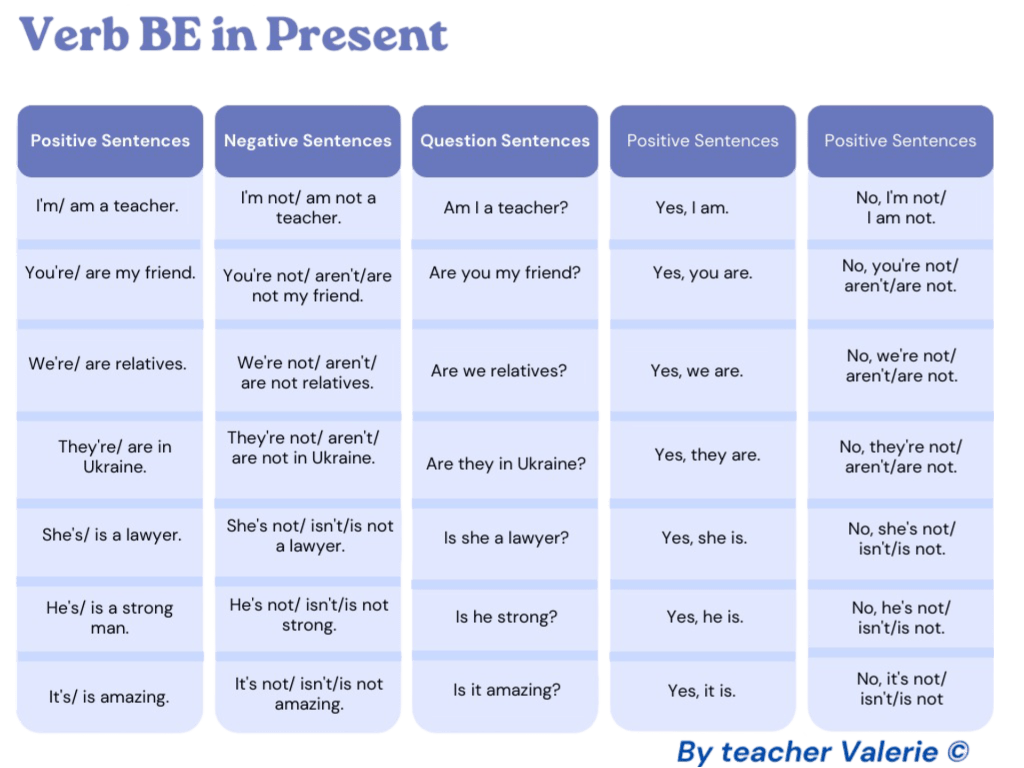
Forms:
- The present simple of the verb BE has three forms:
I am.
He/She/It is.
We/You/They are.
- We use he for a man, she for a woman, and it for a thing, and an animal.
For example:
He‘s a cool boy.
She‘s so pretty.
I like this TV. It‘s so modern.
It’s a big dog.
- We use they for people and for things.
For example:
I love John and Anna. They are my friends.
I love these books. They are very interesting.
Contractions
Contractions or short forms in positive sentences
In spoken/informal English use short forms ‘m, ‘s and ‘re with personal pronouns (I, you, we, they, he, she, it)
I am = I’m sad.
You are = You’re tired.
She is = She’s from Scotland.
But we can also use the short form ‘s with names.
Laura’s beautiful.
London’s an expensive city.
Contractions or short forms in negative sentences
I am not = I’m not sad.
You are not = You’re not = You aren’t tired.
She is not = She’s not = She isn’t from Scotland.
But we can also use the short form ‘s with names.
Laura’s not beautiful.
London’s not a cheap city.
Contractions in short answers
We can only use contractions or full forms in negative short answers, and only full form in positive short answers.
Are you tired? Yes, I am.
No, I am not/ I’m not.
Is she a doctor? Yes, she is.
No, she is not/she’s not/she isn’t.
Are they friends? Yes, they are.
No, they are not/they’re not/they aren’t.
Yes/no & Wh-questions
Yes/no – start your question with the auxiliary verb AM/IS/ARE | Wh-questions – start with the question word (who, what, why, where, when, how) |
| Am I right? | Who is your teacher? |
| Is she your friend? | What is this? |
| Are they at home? | Where is she? |
| Is he from Ukraine? | How is it possible? |
What can we talk about with the verb BE?
- We use the verb be to discuss the following:
Different people and about us: I‘m Valerie, and this is Vadym. And this is Alicia.
Age: I‘m 24 years old, and she is 26.
Talk about the job/occupation : I‘m a teacher, and my mom is a doctor.
Nationality: Ann is from Britain, and Janes is from the USA.
Feelings: I‘m so happy. She is very excited.
Colour: The house is black. His eyes are blue.
Prices: It‘s 5 dollars. This dress is 10 dollars.
The weather: It‘s sunny every day. It is very cold and cloudy this morning.
The time: What time is it? It‘s ten thirty.
Descriptions in general: She is very slim and good-looking. They are very kind. The buildings are old and high.
Key Ideas:
- We always need a verb (an action) in an English sentence. If you don’t have a verb (an action), use the verb BE (am, is, are).
For example:
I am a specialist. (NOT I a specialist)
He is a teacher. (NOT He a teacher)
She is my friend. (NOT She my friend)
They are nice people. (NOT They nice people)
- Keep in mind that some words that are verbs in Ukrainian, aren’t verbs in English.
For example:
Be tired – втомитися – уставать / устать
Be ready – бути готовим – быть готовым
Be proud (of) – пишатися – гордиться
Be bored – нудьгувати – скучать
Be nervous – нервувати – нервничать
Be excited – бути схвильованим / радісно збудженим – волноваться / быть в восторге
Be disappointed – розчаруватися – разочароваться
Be worried – хвилюватися – беспокоиться
Be surprised – дивуватися – удивляться
Be confused – бути розгубленим – путаться / быть в замешательстве
Be embarrassed – ніяковіти – смущаться
Be satisfied – бути задоволеним – быть довольным
- But if you have a verb (action), don’t use verb BE if you talk about a general situation.
For example:
I agree (NOT I am agree).
I go to work every day (NOT I am go to work).
He likes coffee (NOT He is like coffee).
Verb BE Speaking Practice
WordWall Verb be
Answer the questions
Practice talking about emotions
Speaking practice questions
What is your name and how old are you?
Where are you from?
Are you more of an introvert or an extrovert?
What is your favorite thing to do in your free time?
What is your favorite music or band?
Who is someone you admire?
Are you a dog person or a cat person?
Is your favorite season summer, winter, spring, or fall?
Are you more into movies or books?
What is your favorite color and why?
Prepare written answers to the questions & make a recording
Are you good at multitasking?
Is your room usually tidy or messy?
Are you a morning person or a night owl?
Is social media important to you?
Are your hobbies different from your friends’ hobbies?
Is there a sport you are interested in playing?
Are you planning to learn something new this year?
Are you usually on time for school or activities?
Is there a book you are currently reading?
Are you someone who enjoys taking risks?
Verb BE Practice
Present Simple verb be – a lot of tasks